Scrolling through my Instagram explore page, the prototypical vignettes of modern-day girlblogging will inevitably pop up. A deer with a bow on her white-dotted head, overlaid with Arial text: “me core.” Aesthetics of “aloof woman autumn” display collages of black-and-white photos of women smoking cigarettes, black coffee, lingerie, a heart-shaped locket, and a persimmon. White rabbits, angel wings, sad girl playlists, and the lingering image of Sylvia Plath’s fig tree metaphor. Many adolescent girls and young women move through the online looking-glass of girlblogging – which, having sidestepped from early Blogspots, to Tumblr, and now to Instagram – has maintained an aesthetic that has transcended time and space. This Tumblr-branded girlhood embraces, and perhaps precipitously romanticizes, the beauty in the melancholic, often centered around feminine experiences underneath the patriarchal gaze.
Lucila Safdie, the Buenos Aires born-and-raised and London-based fashion designer, is not only familiar with this digital world of deified feminine tragedy, but an active participant in it. Attending a film high school throughout her teen years, she cultivated an interest in fashion simply by being chronically online before everyone else was. Fashion blogging was big in the 2010s. This was especially true on Tumblr, where the girlblogging community embraced a darker, grungier side to femininity while simultaneously celebrating the delicate and tender. The Tumblr girls’ love for Sky Ferreira and Lana Del Rey; their passion for dark, smudged makeup; and their fever for the coquettish symbols of lace, frills, bows, and the color pink, syncretized the fragility of female adolescence with the angst and confusion felt during our vulnerable teenage years. Safdie admitted to Interview Magazine that she used Tumblr throughout her high school and continues to post on the platform, using it as an anonymous diary. Like a diary, Safdie uses her designs to convey intimacies about the teenage-girl experience: rebellion and bucking against parental and social policing, the vulnerabilities of youth, and the vagaries of an adolescent identity.

Throughout our teenage years, we’re constantly trying on new personas, which means new fashion statements. Safdie plays with this instability of style within her own collections, taking inspiration from the shifting obsessions of teenage girls online. Her own evolving relationship to fashion, literature and cinema, driven by curiosity, informs her work. Narrative seems to assume a central role as the basis of her collections: each one has played with melancholic feminine archetypes. Safdie girls are the kind of girls you’d find in Sofia Coppola films, which makes her first collection’s name, Lick the Star, even more perfect: it references Sofia Coppola’s first short film, stepping in Coppola’s footsteps as a creative who speaks directly to women.
When she was asked about the first collection by Interview, she said “she didn’t think about it very deeply.” I wonder if that wanton, carefree, subconscious-at-work mode of designing was a way for Safdie to tap into the rawness of a girl’s teenage years. Lick the Star’s looks waver somewhere between a school girl aesthetic and 2010s party girl – can you spot the online influence yet? Short-shorts of silver and gold-foiled jersey, ruffled and bearing Letterman-like numbers, evoke a high-school cheerleader’s uniform. A plaid-patterned dress sports a paired tie, while another look contrasts a lacy, lingerie-esque cropped sweater and matching tights. Safdie mentioned in a Vogue interview that the collection was inspired by 2010s American Apparel, tying back to the references Safdie loves to circle. Of the online community that first introduced her to fashion, Safdie told Vogue, “Being ‘a girl online’ is a cliché for a certain type of young woman who’s into melancholia and Sylvia Plath. I was that person, and I am still fascinated by that complex, coming-of-age period in a person’s life. It’s the main point of reference within my work.”
Elevating, and even celebrating, controversial embodiments of girlhood is a throughline throughout her collections. Her second collection, Girls Don’t Cry, was inspired by the teen girl who shoplifts. Gold-foiled jersey returns in these looks, but Safdie graduates to silhouettes that remind me of the peplum-crazed, almost business-casual looks of the early 2010s, when girls went around in black shirts with Peter Pan collars, teal and coral-colored structured skirts, and smatterings of stripes. Elements of the ensembles take on these motifs: a rounded collar actually appears as the waistband of a pair of gold-foiled shorts, grey and yellow stripes abound, and a structured, teal, business-casual dress stands out among the pieces. But the rebellion and subversion of our shoplifting teen main character feature even more prominently. Seemingly-discordant patterns, like stripes laid over lace; bright colors; and a signature, structured, pantless bodysuit with puffed sleeves, an asymmetrical collar, and a series of emphasized zippers test the limits, embodying the character of the shoplifter more than replicating exactly the kind of what she would’ve stolen from a 2013 shopping mall. A white T-shirt with bold black script declaring the tee “STOLEN FROM Lucila Safdie” makes this archetype obvious: the fashion-obsessed rebel, one with the trends but not afraid to clear her own path. She blows bubblegum and tells you to fuck off, and she possesses an inner world you’re desperate to unravel. She’s the star of The Bling Ring maybe – or a 2010s girl taking inspiration from it.
Her third collection, “i desire the things that will destroy me in the end,” lifts its title from a Sylvia Plath quote. The polka-dotted, floral-patterned collection displays Safdie’s signature ruffles and lace, with some of the designs harkening back to Lick the Star. Safdie emphasized in her article with Interview that even when exploring the sad girls of the 1960s, she’s still doing so with the lens of internet-obsessed girls today. Her designs are a deliberate exploration of the modern, girl-blogger psyche: the sometimes-problematic romanticization of the past, and a kind of glorification of female melancholy that for many women led to horrific ends. Online today, we see a lot of making-fun of these kinds of girls, right alongside the mass amount of content intended for this demographic. Sometimes memes buying into and ridiculing the sad girl come from the same accounts. It creates a kind of online tension, a question of whether or not these attitudes are “cringe” or “socially acceptable.” Safdie asserts her own opinion in her work. She told Interview, “Even if it’s a cliché of a girl who’s into that stuff, it’s cool.” She validates the facets of teenage girlhood that are often considered melodramatic, hysterical, or stupid by a broader patriarchal culture; instead, she calls it high fashion.

Image sourced from Document Journal.
Moving from the 2010s teen, to the shoplifter, to the 60s intellectual sad girl, Safdie explored the ‘50s exploited starlet in her fourth collection, Farewell Princess, named after a New York Post article announcing Grace Kelly’s death. Collars, lace, ruffles and structured shoulders all reappear in this collection –Safdie’s quintessential elements of the feminine– but new shapes, colors, and the a feeling of “slouch” emerge in this collection. Some draped, baby pink looks call to mind Audrey Hepburn’s ballet background. Ruffle shirts with the word Goddess printed asymmetrically down the front might gesture towards the deification of these Hollywood women, who were mercilessly torn apart by the same media that obsessed over them. Other looks are more explicitly royal and Grace Kelly-esque, featuring damask patterning. A white dress with black lining, tied in the center by a bow, looks like a 1960s leading-lady’s slip in a dramatic romance scene.
It’s evident throughout her collections that Safdie’s interested in the psychology of contemporary girlhood: she’s looking through the lens of today’s girls, who are looking at the past. Their follies, misinterpretations, and dreamings of these tragic female figures come to life in the designs. Safdie uses the Internet as a tool to understand the meanings girls’ find through clothing and through caricature. She told Office Magazine that authentic items she finds on eBay and Vinted inspire her work. But, undeniably, so does cinema, which is heavily focused on the aesthetic constructions of a character. A director wants to convey the personality of a character through wardrobe and visuals, and Safdie harnesses that power within her own work. In the same interview, Safdie cites Prince Charles Cinema as a go-to spot for her, and her investment in film extends even to her own girls’ only film club, which hosts screenings of movies by female directors for a posse of London cool girls.
Safdie took on new heights of narrative investment with her most recent collection, the first to premiere at London Fashion Week, titled Tristesse Impériale. Rather than focusing on the modern aesthetic understandings of a vague group of historical sad girls, she honed in on the devastation of the Romanov sisters. The collection unites her interests in the themes of broken girlhood and the power of monarchy and fame. Tristesse Impériale uses and displaces royal aesthetics – pearled belts and necklaces, ruffles, lace, corset-like bodices, and pleats – once again reimaging these ideas for the wear and resonance of the modern, internet-obsessed teen girl. This girl took a deep-dive on Wikipedia, and she’s thinking about the Romanovs in her World History class. Safdie told Dazed, “It’s the idea of the Romanov girls, their doomed girlhood and the idea of transforming these sisters into immortal saints.” One body suit bears the impressions of an imperial portrait of the girls, their forms peaking through the fabric like Jesus’s face on the Shroud of Turin. Safdie balances wearability and the concerns of the contemporary It-girl with the heightened emotional stakes and drama of our girlhood imaginations, and how they conjured up these historical female figures with idolization, even of their misfortunes. Tristesse Impériale and Farewell Princess are two collections that really serve Safdie’s purpose: to find the similarities between girlhood then and girlhood now.
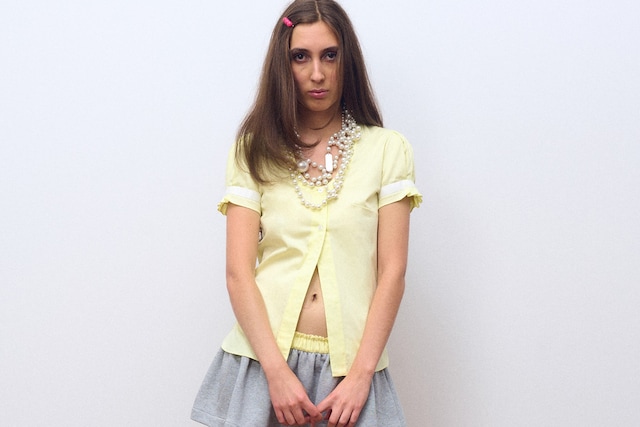
Image sourced from Dazed.
Safdie admitted to Interview that while attending Central Saint Martins, she didn’t want to experiment with shapes; in her discussion with Dazed, she expressed that she wanted her clothes to be wearable and comfortable. I think what’s radical about Safdie’s clothes is that they are actually made for the teen girl in mind, and her designs –especially with her references to cinema, feminine interests, and online culture– serve as a beckoning call for girls who are interested in shitty, melancholic and tragic oppressions of girlhood. She focuses on the restrictions and confinements of girlhood, while also making clothing that liberates those girls: she lets them feel comfortable, express themselves, and play with sexuality. Everything the patriarchy tells girls not to do. Her film club is obviously aligned with her desire to generate a female-centric community. It brings together lovers of sad-girl films to celebrate female directors, finding commonality through the shared contemplation of female figures who came before us and negotiated these enduring standards of patriarchy. More than that, her work elevates “cliché,” often ridiculed images of “sad girl” femininity to the heights of high fashion. Even though Safdie seems to be poking fun at her former, digitally-immersed, Tumblr-obsessed adolescent self, she celebrates and makes a space for that girl, too. And she now makes that place for her on one of the world’s most revered stages: the catwalk of London Fashion Week.
 Kira Manelski
Leave a comment