
A week or so ago, I attended a week-long family event, heartwarmingly reunited with many relatives I hadn’t spent significant time with in decades. Friends of my family members were there, too – I endeavored to feign extraversion and treat with the other guests, almost all of whom were a decade or so older than me. For four days, I was dangerously released from my digital and interpersonal echo chamber of anti-A.I. creatives and unceremoniously dumped into the wild landscape of millennial tech, advertising, marketing, and HR professionals. After I fought with my uncle about his belief that we must be the benevolent stewards of Earth’s new dominant life form, artificial intelligence (in public), my twin sister and I mediated a discussion between a married couple about ChatGPT being their relationship therapist. It appeared as if everywhere I looked, there was someone over the age of 25 readily embracing A.I. While I’d been exposed to my fair share of peers using A.I. for academic purposes during my time at college, I’d been completely unaware of how deeply artificial intelligence has penetrated the intimate and work lives of those only seven years my senior – and I was even more alarmed when I learned that my fifty five-year old uncle had fed one hundred years of our family historical documents to Claude to research our own bloodline.
The night of the culminating dinner, I was slumped over in my elegantly upholstered chair, impatient to kick off my high heels and collapse into bed. In between the appetizers and entrée, one of the millennial finance fiancés that I was placed next to in the seating arrangement approached me for a conversation. With his slack-fitted blue suit, his slicked brown tresses and rectangular hairline, and his habit of checking his phone any time there was even a slight lull in the discussion, I could very easily envision him in an embroidered-logo Patagonia fleece, jogging down a sidewalk abutting the piers in Seaport, and then clocking in for work in FiDi before stopping for a sweetgreen salad for lunch. He asked me how I, as someone interested in writing for fashion and culture, would go about styling a man. I appreciate the question for the sake of curiosity and forwardness, but as I told him, personal style is about taste. Finance Guy lamented that he felt he looked like everyone else in his peer group, which I guess I just affirmed for him, but I resonated with the reasons he cited for this. It was easy to look at everyone else and duplicate, knowing that he wouldn’t be judged for his choices and his colleagues would find his appearance respectable. While the finance bro-code isn’t difficult to scorn, I have to imagine that the uniformity not only derives from convenience, but a hyper-awareness that conformity is highly valuable social capital in the midst of a cutthroat, money-minded community. It also made me ask just how many millennial men are asking A.I. what they should be wearing on a daily basis in order to achieve that ideal.
I responded that if he didn’t know which pieces he instinctively gravitated towards in a retail store, he should first interrogate his tastes in other arenas. Who is his favorite visual artist? If he doesn’t have one, he should go to a museum and be conscious of which paintings he idles in front of and which ones he slips past without note. What are the elements of design, geometrical angles, or visual qualities which attract him to the piece? What music does he enjoy? Is there a song he has argued is good or bad while at the bar with his friends, passionate enough about his opinion to make his perspective a sticking point? Why was it so important to him? Taste is ultimately a profile of one’s portfolio of instinctual feelings. The curation of personal taste has to do with an almost animal quality, similar to natural curiosity or attraction – it’s about someone’s interaction with and exposure to the world around them. What things you like or don’t like are an integral dimension of what makes you, you. On a recent episode of the Polyester Zine podcast, Ione Gamble and Gina Tonic noted that like most things that were once purely contextual or interpersonal, taste has been revolutionized by the internet. Now, we can classify our taste as objects we could never afford to own, clothes seen on foreign runways, and Basque-language movies that we couldn’t have stumbled upon in a Blockbuster. In many ways, the internet has democratized taste, allowing our yens to extend to material that might have only been accessible to the wealthiest echelons of society. Now I can say that my favorite luxury brand is Chloé despite not having a single garment by the brand hanging in my closet. But Emily Segal’s viral Substack essay, TASTESLOP, which made waves online last month, outlines how the internet and artificial intelligence specifically might be threatening taste. While Segal makes some significant and salient points, I disagree with her tendency to speak about taste as if there is some universally agreed upon notion of “taste” and to categorize any opinions or wants which lie outside that framework as lacking this desirable quality.
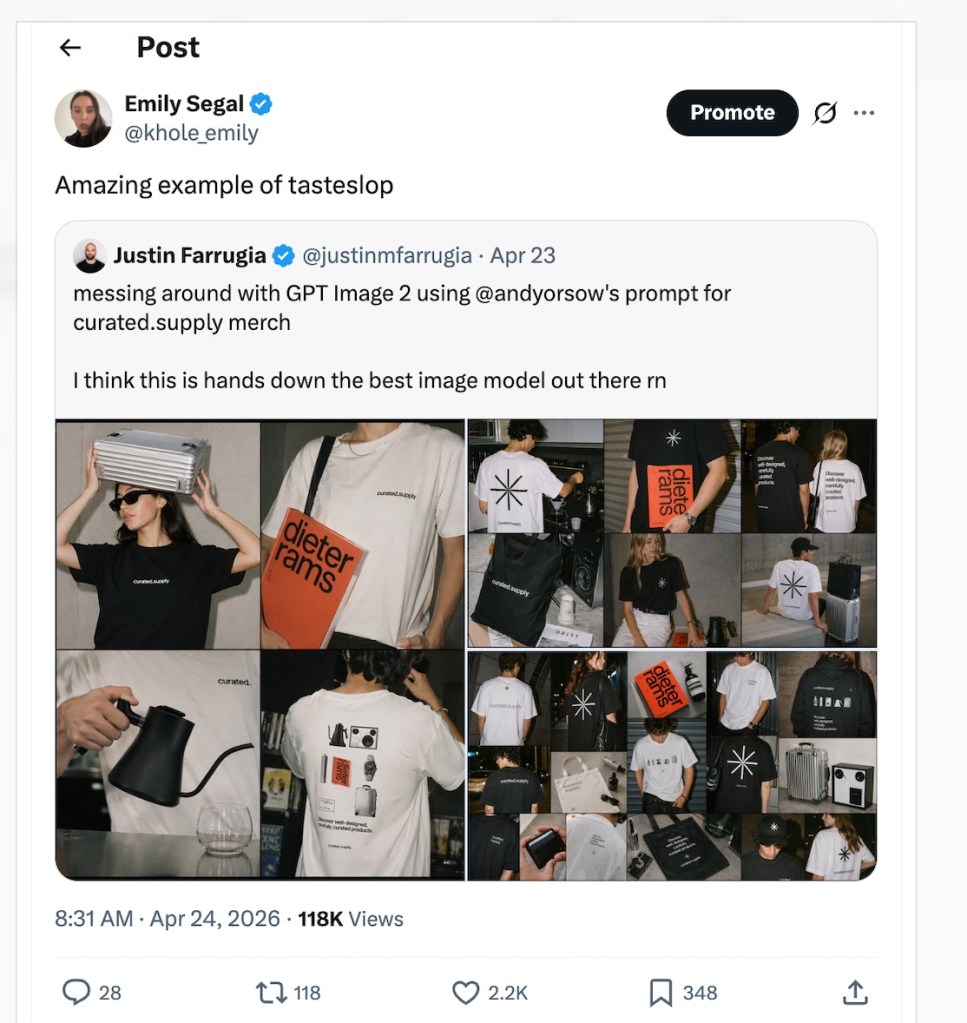
Segal defines tasteslop as A.I “slop made out of things considered to be tasteful,” like images that employ popular modernist design elements or “fetish items” (i.e., items the wealthy consider as trendy or interesting, like coffee table books with Arial-font titles and overly-expensive kitchenware); “tasteful things deployed in service of slop” (she uses a fancy influencer dinner hosted by Claude as an example); and the online discourse about taste which cyclically returns to A.I.’s potential instrumentalization in creation of taste. She goes on to state that she believes that taste requires discernment, personal connection and context in relation to a particular item or aesthetic, and the ability to historically validate the inclusion of a trend, object, clothing item into the pedigree of “taste.” She writes, “I would say that the biggest thing people are missing about taste across the board is that it is relative, contextual, and social. Taste needs to be socially validated. There is no such thing as taste if it falls in a forest.”
Segal characterizes taste by the society which surrounds it. If a specific notion of taste is socially validated – like carrying a Trader Joe’s bag in Japan, which is one example she cites – that is true “taste,” even if it seems quotidian to an American, who lives somewhere Trader Joe’s totes might be readily available. But what I don’t appreciate is that Segal seems to denote taste as something which requires a degree of scarcity, and even more than that, the idea that a social hierarchy does and should define taste. To Segal, this hierarchy is what the A.I. models are ultimately threatening. She writes, “I have a Togo couch and multiple pairs of tabis and I think they are both definitively vulgar at this point (or at least cheugy), specifically because they have accrued so much emphasis as expensive high design objects. They are obvious.” I’m unnerved by this idea that taste is only threatened by the internet and A.I. because items that were once exclusive to the wealthy, like a Togo couch or tabis might have been, are now socially symbolic of a particular class. And, they are more easily acquired because, knowing that these shoes are status symbols, people of different social classes can now save up for these products, allowing images of the product to proliferate further online and for the items to become more iconic. It seems as if Segal is falling into the trap of “quiet luxury” – another social media term arrested and beaten into nothingness, assigned to style icons like Sofia Richie, who wear slightly less obvious status symbols than Gucci belts or LV logo bags– being the definition of “taste.” What bothers me is that it appears that this definition of taste is class-dependent, and also relies upon the premise that taste remains exclusive and enviable. Emphasis on the “quiet” in quiet luxury.
Segal goes on to designate her tastemakers as “professors, artists, intellectuals, and cultural specialists” who might not have the billions that tech CEOs have – Segal’s hijackers of taste. But these people still have access to highly exclusive circles, just ones that don’t rely on advertisement for existence like the tech industry does. The art world is similarly restricted and pretentious, and professors and cultural specialists can only acquire the knowledge they possess by doling out hundreds of thousands of dollars for higher education, which is why these circles are often populated by generational wealth. The art world will one day be populated by the children of the tech CEOs Segal discusses, because tech’s new money can now pay their way into these private cultural spaces – and may even eventually be dependent on their donations to remain afloat. The tastemakers, in Segal’s definition of the world, remain those with fiscal capital, even if they exercise cultural capital in a less “ostentatious” way, and these rich people are less focused on overt display.
I absolutely agree that A.I. threatens taste, but not because A.I. generated images employing symbols of cultural capital have routinely made these objects and styles identifiable through the ubiquitous reproduction of their likeness. A.I. threatens taste because it can be manipulated, and because in the process of their endless reproduction of what is already trendy, it is preventing people from forming the intimate connections with aesthetic, media, clothing styles, and objects which previously defined personal taste. It omniprescence of A.I. -generated images containing these post modernist design elements and tabis have made the objects soulless, not just “obvious,” because a language learning model can’t have a tactile experience with an object. A.I. can’t experience the emotional response many have to modernist art and design, or relish in the odd feeling of wriggling your foot into a leather shoe shaped like a goat’s hoof, imagining what it might be like to sneak a cigarette in the crease like you’ve seen online. The pervasiveness of the objects online is not as threatening as the removal of human interpretation of those objects and styles, and the sensory and thoughtful experiences humanity has with any form of art or design. It’s this process which A.I. cannot replicate. A.I. can’t have taste because A.I. doesn’t have a soul with which it can imbibe art, whether it be popularly appreciated symbols of cultural status; the music of your neighbor’s garage band; or your toddler’s haphazard crayon drawing taped up on the fridge.
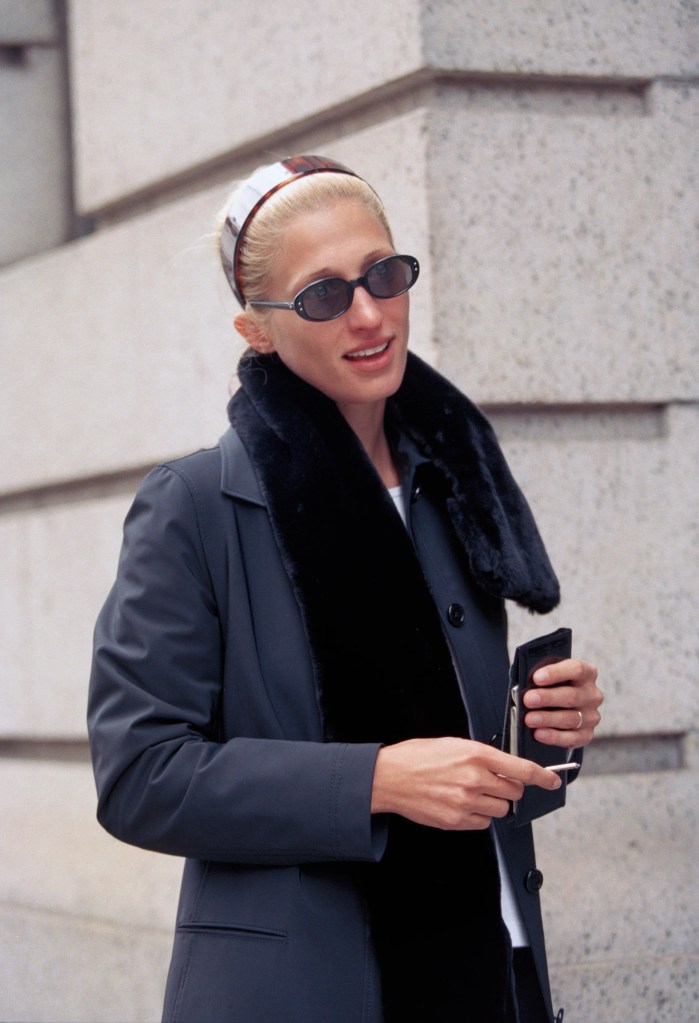
It reminds me of the discourse which cropped up online regarding Carolyn Bessette Kennedy when Ryan Murphy’s Love Story was releasing episodes weekly this past spring. While CBK has always been a cultural and style icon to many, her re-entrance into the public consciousness through being transformed into a tortured television heroine resulted in a proliferation of online content about dressing like her. There was ensuing backlash from other influencers about the replication of CBK’s style, lamenting the exhaustion of trend cycles which last six to eight weeks and aren’t innovative, but imitative. While I agree with the notion that the constant regurgitation of trends and the resultant lack of personal style is alarming – as well as the fueling of consistent capitalist consumption – at least there is a personal connection there, a human quality of admiration which is propelling this reproduction. Watching a woman, even a fictionalized version of a Kennedy woman, struggle on screen and relate to her, aspire to be like her: that is human. I would like to take the critique one step further though, which I also saw many people note online. Part of the reason why CBK’s style choices were so admirable was her caring relationship with her clothes. She rewore the same garments, and she patched and sewed the pieces she loved, even though she had a reservoir of wealth she could tap for replacements when they became worn. She dressed for the practicalities of her lifestyle as a working woman and a political wife. Such care for her clothing implies a tactile relationship with the world around her, an almost reciprocal relationship with her clothes which suggests a sense of value for what she owns and a sense of her own self. The relationship CBK maintained with her clothes demonstrates a consciousness of how she would like to feel and how she would like to present herself. I think in our own personal taste and relationship to the world around us, we should aspire to emulate those qualities. CBK is an icon not for just how she dressed, but her the profundity of her taste – her instinctual relationship to art and the material world, including the material of the garments she wore.
This goes back to Finance Bro. When Finance Bro criticizes himself for not having ‘taste,’ or being ‘basic’ and following socially-affirmed trends, what he is really feeling himself to lack is that instinctual quality which drives him towards choosing and care of specific garments and outfit combinations which express something about himself. Rather than displaying these fundamental qualities of personal taste to the world, he instead represents the class echelon which he is a part of – wealthy, young Finance Bro nation – which of course feels reductive and silly. If we were defined only by an occupation it is difficult to truly connect to, we’d all be very boring people. I truly believe that everyone is “interesting” and unique if they have the space and the resources to unfold. No one, regardless of class, wants to be defined by their class unless they believe demonstration of class unveils and implies a yearned-for superiority over others. While Segal identifies ‘obvious’ items of wealth display (like now tabis and Togo couches to her dismay) as tasteless, utilizing items of the ‘quiet luxury’ genre or material considered exclusive to smaller circles to define the epitome of taste is equally class-dependent and hierarchical. As Gina and Ione said it on the Polyester Zine podcast, “There is a specific subset of people and creators that have found it affronting that these ideas have become more accessible because then it devalues their own taste, whereas when I think taste is interesting, is when it is not that… It’s not hierarchical, it’s not exclusionary, it’s about embracing the things that we actually like, which is increasingly difficult in an A.I. and algorithm-led world.”
We should detach ourselves from this purported “universal,” hierarchical, class-defined and exclusivity-defined notion of taste, instead looking to see how the democratization of identifying with material and art can allow for more concrete definitions of personal taste and greater accessibility to facets of our individual selves. With greater knowledge of artistic material we could connect with, we know more about ourselves and our artistic tastes. Ultimately, through exposure to culture, fashion, design objects and art, we expand our own potential to create. Everyone should have the right to be exposed to the items and artistic practices Segal regards as tasteful because they are exclusive, because that is what is fair, what is democratic, and what is owed to us. Culture, including fashion with regards to clothes or interior design or coffee table books, should never be behind a paywall, a concept the art and academic world Segal praises continues to grapple with. Mainstream or “basic” taste, therefore, should be decided by objects’ true popularity, the number of a piece of art, material, or trend resonates with. The mainstream, the trendy, is not “good” or “bad” taste because taste is not defined by either popularity or esotericism. Instead, personal taste is defined by one’s own biases, interests, and connections to media. Universality and popularity implies the ability for many people to resonate with ideas and images, which is not a bad thing. The issue with A.I. and controlled algorithms is not that ‘tasteslop’ is increasing exposure, but that the exposure of these images with redundant objects, design elements, and themes, A.I. and algorithms are creating an echo chamber which, while increasing visibility of expensive, once “esoteric” and economically exclusive items, is also burying internet users with images of the same kind, all of which are effectively working as advertisements to promote consumption. These A.I.-generated images and the algorithms which benefit are the only images we have access to on our For You and Explore pages, programmed to supply us only with content that massive tech and artificial intelligence CEOs benefit from promoting. While increasing our knowledge of once-esoteric or exclusive luxury items, such an algorithm also decreases the visibility of indie art and less financially-backed projects and ideas. The niche that isn’t quartered off from the public by economic exclusivity, but by obscurity, is increasingly difficult for internet users to discover, making the life of a creative without generational financial backing that much more difficult.
A.I. doesn’t have a personal connection to the art it reproduces for us to view. It is pumping out these advertisements on an assembly line because someone has paid it to do that. There is no good or bad taste, there is just yours, and that taste should be able to exist outside of capitalist hierarchy, whether that hierarchy is being pushed by the exclusivity of culturalists with a specific set of knowledge, aided by financial resources; or that capitalist hierarchy is being built by billionaire tech CEOs who want you to like what benefits them financially. All in all, like what you like, and in an increasingly A.I.-defined world, seek out that which could expand your taste rather than passively accepting what the algorithm feeds you. Not because the algorithm is making rich people items less esoteric, but because you deserve to know what’s out there – whether they are $1000 tabis or a freelance artist’s passion project. There are no good or bad things to like. Only your own gravitation.


Leave a Reply